Largest Ara contingent ever heads to OPSITARA research symposium
04 December, 2025
Research reflects breadth of innovation and inquiry across programmes
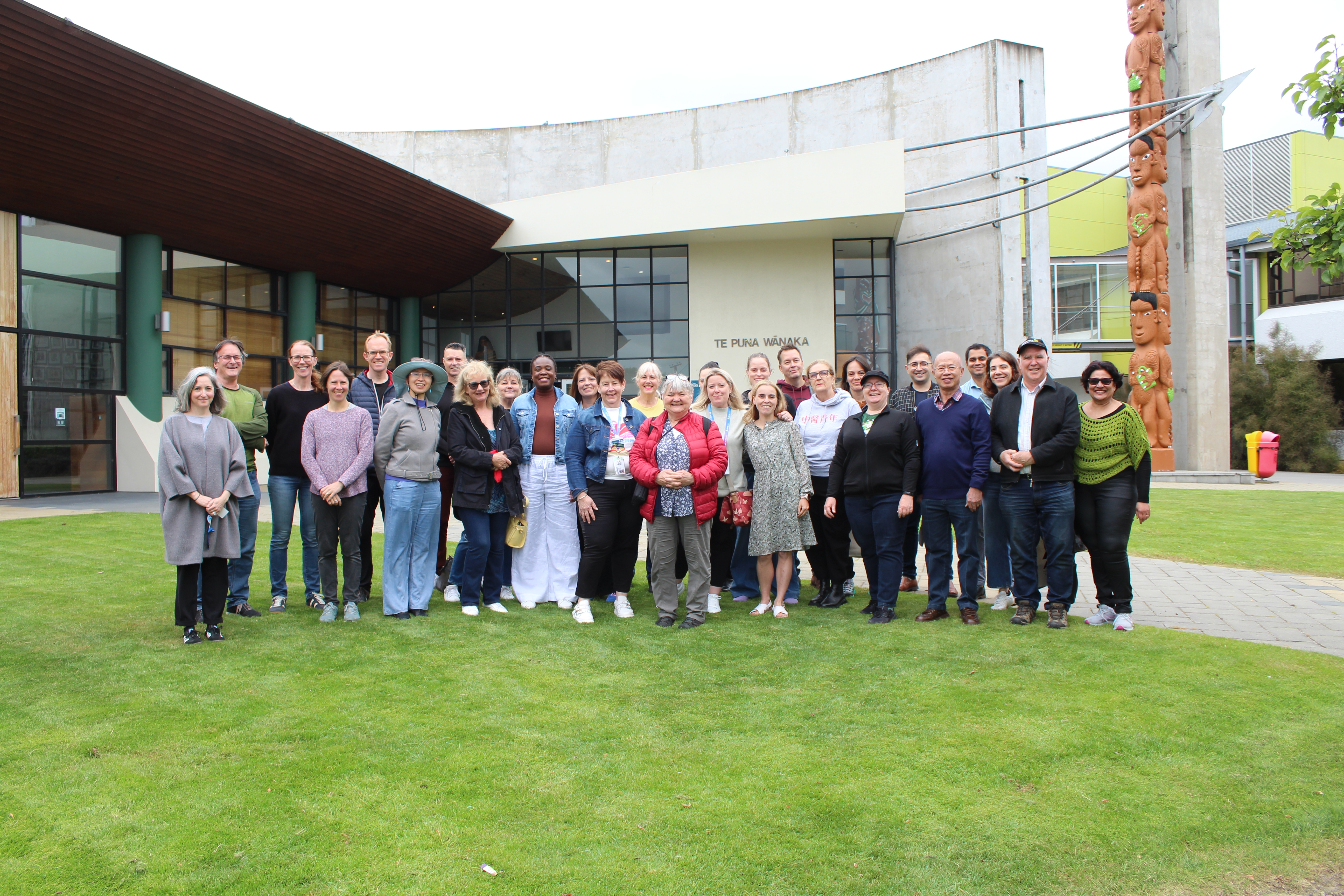
Some of the Ara kaimahi gathered on City campus before heading to Ōtepoti Dunedin
Ara Institute of Canterbury has proudly sent its largest-ever group of researchers to the OPSITARA Research Symposium, being held at Otago Polytechnic on 4–5 December.
The annual symposium brings together researchers from across Te Wai Pounamu (the South Island) vocational education sector to share ideas, innovations and applied research.
With 34 oral presenters and six posters, Ara has the most input of any organisation in 2025. The team is showcasing work across health, education, engineering, digital technologies, creative practice and Mātauranga Māori - reflecting the depth and diversity of applied research underway at Ara.
Ara Director of Ako Excellence, Deb Young, said: “Our research work reflects the breadth of innovation and inquiry happening across our programmes - from AI in nursing education and vocational learning, to sustainability, indigenous knowledge and creative practice.”
Subject highlights across the programme include:
- Health & Nursing Education: AI-assisted gamification, clinical reasoning and Māori health nursing.
- Education & Digital Learning: Online learner journeys, HyFlex delivery and personalised learning environments.
- Engineering & Built Environment: Automation, sustainable housing and digital technologies.
- Creative Practice & Mātauranga Māori: Indigenous knowledge integration, creative sustainability and innovative design.
- Posters: Topics ranged from osteopathy and early warning systems to sports science and food technology.
"OPSITARA is always an inspiring and energising event," Young said. "Seeing the range of ideas and the passion our researchers bring to the table reinforces Ara’s role as a leader in applied research.”
Ara Contributors:
Posters
- Non-specific chronic low back pain: What does osteopathy do? – Anne-Lise Girardin
- Lecturers’ Perspectives on AI in Nursing Education – Avril Guihen
- Clinical Reasoning & Differential Diagnosis of Abdominal Pain – Warwick Shillito (presented by Peter Olsen)
- Early Warning Score Implementation – Jodie Burland (presented by Suzy Hodgson)
- Warm-up protocols and sprint cycling performance – Tyson Huia
- Fatty acid composition of ruminant milk cheeses – Mary Fitzpatrick
Speakers
- AI-Assisted Gamification in Nursing Education – Sara Vermeulen
- Disconnected or empowered? Online Learner Journeys in an AI-Driven World – Suzanne Hodgson
- Industry Project Redesign for Engineering Graduates – Sundeep Daggubati
- Embedding Te Ao Māori into Architectural Competency – Bernadette Muir
- Rongo ā Puku – Gut as a source of intelligence – John Osborne
- Strengthening Tiriti o Waitangi and Māori Health Nursing – Maryann Wilson
- Equity for success – Kerstin Dofs
- Swim Cap Shape and Drag – Helen Marshall & Lindsey Alton
- A LuluScope – Thomas Cronje (presented by Yao Li)
- Lean Thinking in Quantity Surveying Education – Nilmini Thilakarathna
- Blind But Fair? Anonymous Grading – Lindsey Alton & Ian Chesterman
- Family Engagement in Nursing Practice – Anna Richardson
- Collaborative AutoEthnography & Sustainability Practice – Allen Hill & Adam Brasell
- Inclusive Design and Real-World Solutions – Andrew Wallace
- Home Design for Work From Home Families – Phillip Etherington
- AI in vocational education: personalised learning environments – Selena Chan
- Weaving Te Tiriti and Te Reo into BSOE – Lena Mkwara & Rachael Pelvin
- Kickstarting creativity through monoprinting – Carol King
- Images That Decompose: Rethinking Photographic Materials – Wendy Clarke